
Guide
How to find the value of your Pokémon card collection
Working out what a collection is worth is mostly about being careful: knowing exactly which card you hold, looking at the right prices, and adding it up honestly. Here is how to do it step by step.
Updated 2026-11-17
1. Start with a complete list
You cannot price a pile, only individual cards. Write down each card's name, set, card number and printing. The printing matters: a normal, a holo and a reverse holo copy of the same card are different items with different prices.
2. Look at real market prices
Use sold prices, not asking prices. An asking price is what a seller hopes to get; a sold price is what a buyer actually paid. Price guides and marketplaces that show recent sales are the most reliable starting point.
3. Account for condition
Most price guides quote near mint copies. A card with whitening on the edges, creases or scratches usually sells for less, sometimes much less. Professionally graded cards have their own prices and should not be mixed in with ungraded ones.
4. Add it up, and look at the top
The total is the sum of price times quantity for every card. When you do it, you will almost always find the same thing: the value sits in a small number of cards, and most of the collection is worth cents. Look at your top 10 cards separately, because those are the ones worth protecting and checking most often.
5. Treat the result as an estimate
Prices move, and the number you calculate is not what you would get if you sold everything today. Fees, shipping and the time it takes to find buyers all reduce what lands in your pocket. Think of the total as a well-informed guide.
6. Track the value over time
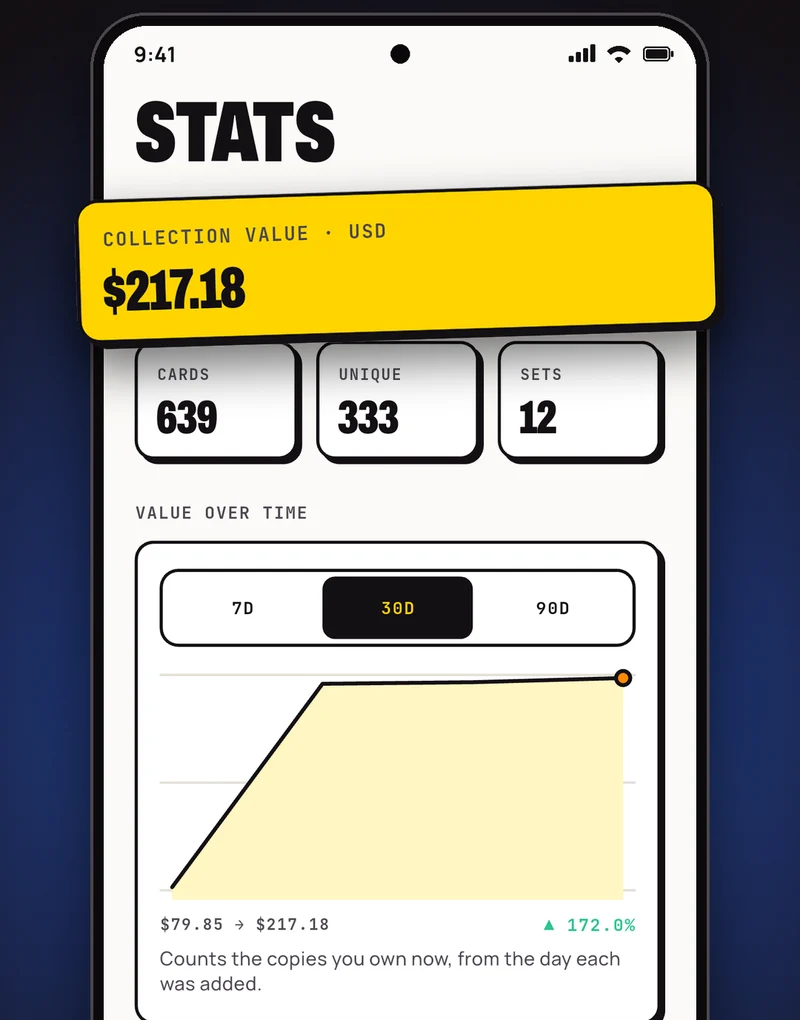
Check again every month or two. A single snapshot tells you little; the trend tells you which cards are climbing and which are not. If you also note what you paid for each card, you can see your real profit or loss.
How Decksy helps
Decksy does the arithmetic for you. It shows a market estimate for every card, adds it all into one collection value, charts the price history, ranks your most valuable cards and, once you add what you paid, shows your profit and loss. Prices are market estimates in USD and may differ from real sale prices.